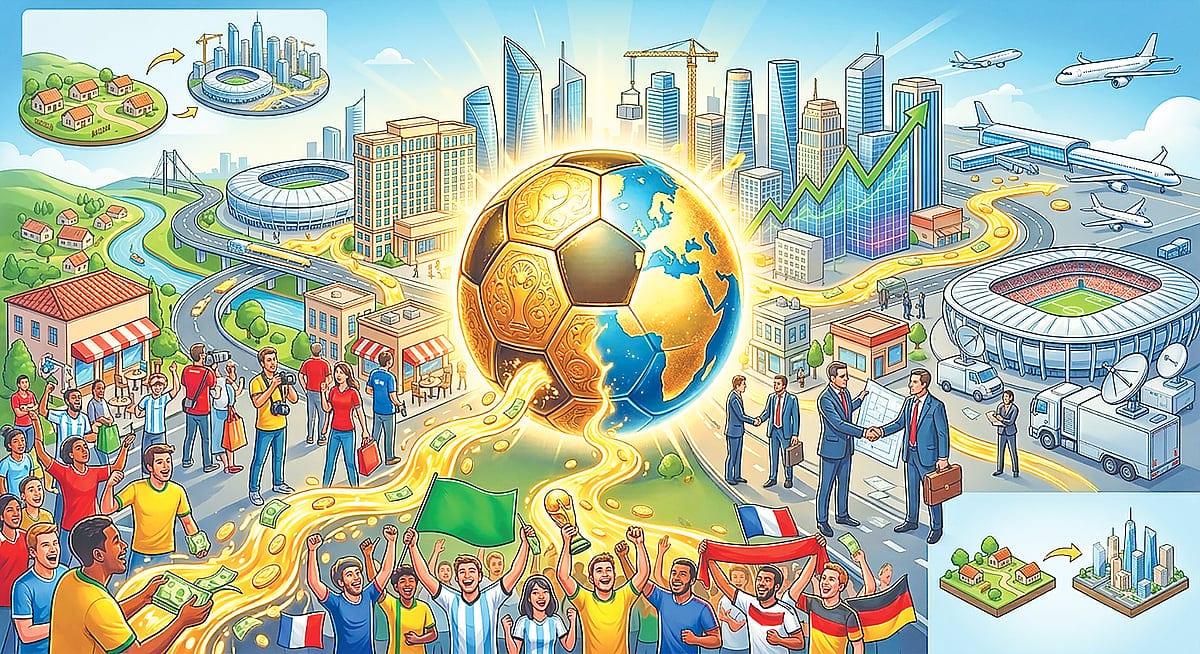
The FIFA World Cup, the pinnacle of international football, has far-reaching economic implications. Beyond the excitement of the games, the tournament stimulates economic activity, creates jobs, and boosts local businesses. According to FIFA, the World Trade Organization, and Open Economics, the 2026 World Cup is expected to generate $810 billion in economic activity worldwide, with $350 billion in the United States and $460 billion in other countries. This includes $490 billion in net economic benefits after accounting for all expenses. The event is also projected to increase incomes by $280 billion globally, with $120 billion in the U.S. and $160 billion elsewhere. Employment is another significant beneficiary, with an estimated 824,000 full-time equivalent jobs created worldwide, including 185,000 in the U.S. and 639,000 in other nations.
Historical Context and Future Projections
The World Cup has evolved from a small-scale event in 1930, involving just 13 teams, to a massive tournament in 2026 with 48 teams. This expansion not only increases the number of matches and spectators but also enhances broadcasting revenue and business opportunities. However, the economic benefits are not guaranteed for all host countries. For instance, while Germany in 2006 saw significant economic gains due to its robust infrastructure, countries like South Africa in 2010 and Brazil in 2014 faced substantial losses from overspending on new stadiums and infrastructure. Qatar's 2022 World Cup, despite high expenditures, saw lower returns compared to its investment. Yet, the tournament often serves as a platform for national branding and economic diversification, as seen in Qatar.