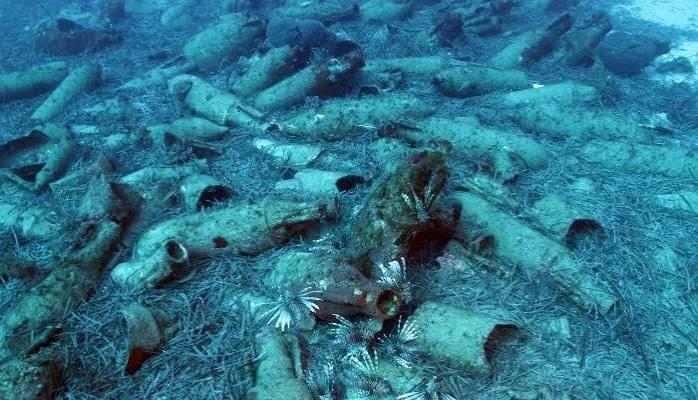
An extraordinary underwater discovery has shed new light on Roman maritime trade. Italian divers recently uncovered a 2,100-year-old shipwreck off the coast of Sicily, packed with hundreds of well-preserved amphorae. This find, hailed by Italy's Culture Minister as one of the most crucial underwater archaeological discoveries in recent years, offers a rare glimpse into the commercial practices of ancient Rome.
Discovery and Context
The ship, which is estimated to date from between the 2nd and 1st centuries BC, was located approximately three miles off the coast of Mazara del Vallo. Divers from the cultural heritage protection arm of Palermo's police made the discovery at a depth of 46 meters, following a tip-off from local fishermen. The vessel, which measures about 21 meters in length and 6 meters in width, was almost entirely filled with Dressel 1A amphorae.
Dressel 1A amphorae are tall, cylindrical containers primarily used for transporting wine. These amphorae were a common sight in ancient Roman trade routes, facilitating the distribution of wine across the Mediterranean. The condition of the amphorae found on this ship suggests that they may have been well-preserved underwater, shielded from the elements that typically cause decay on land.
The divers who found the wreck, Giacomo De Mola and Igor Bisulli, recounted their astonishment at the discovery. De Mola described how poor visibility initially obscured the wreck, but upon closer inspection, he was stunned to find a vast expanse of amphorae below. The divers shared their experience and video footage on social media, sparking widespread interest in the find.
The significance of this discovery extends beyond its archaeological value. It provides valuable insights into the economic and trade practices of ancient Rome. The amphorae, along with any other cargo or artifacts found on the ship, could offer clues about the routes and methods used by Roman merchants to transport goods across the Mediterranean.
Moreover, the wreck serves as a testament to the enduring legacy of Roman maritime activity. It highlights the importance of Sicily as a crossroads of trade and culture in ancient times, a role that continues to resonate in the region today. The find is expected to contribute significantly to our understanding of Roman history and the broader context of ancient Mediterranean trade.