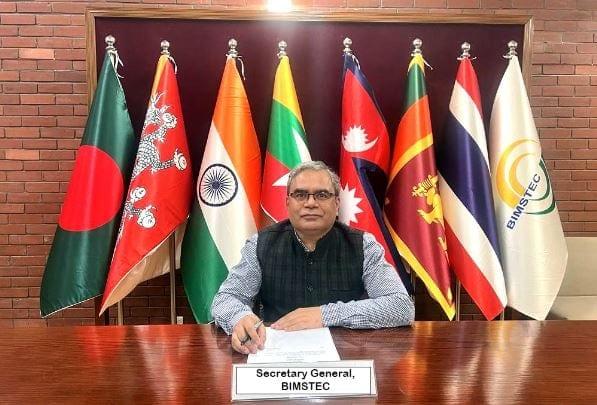
BIMSTEC Secretary General Indra Mani Pandey today criticized comparisons between BIMSTEC and SAARC as'misleading and misplaced', arguing that such comparisons ultimately hurt the interests of the Bay of Bengal regional grouping. Speaking at the BIMSTEC Secretariat in Dhaka, Pandey told members of the Diplomatic Correspondents Association, Bangladesh (DCAB) that BIMSTEC should be assessed based on its own mandate, achievements, and potential rather than being viewed through the lens of other regional organizations.
Pandey emphasized that regional cooperation is essential for ensuring development and security across the Bay of Bengal region. He highlighted BIMSTEC's role as a dynamic and effective platform for advancing the shared aspirations of its member states. The Bay of Bengal Initiative for Multi-Sectoral Technical and Economic Cooperation (BIMSTEC) serves the core security and development interests of Bangladesh and its other member states.
'BIMSTEC is a real and present opportunity, not a remote and hypothetical possibility,' Pandey said, underscoring the need for member states to make optimum use of the platform to deepen regional cooperation. His remarks come as BIMSTEC seeks to accelerate the implementation of decisions taken by its leaders and strengthen cooperation in priority areas ranging from trade and connectivity to security, the environment, and people-to-people contacts.
Bangladesh currently holds the chairmanship of BIMSTEC, having assumed the responsibility from Thailand at the Sixth BIMSTEC Summit held in Bangkok in April 2025. The summit marked an important milestone in the grouping's institutional evolution, with the leaders adopting the BIMSTEC Bangkok Vision 2030, which outlines a roadmap towards a 'Prosperous, Resilient and Open BIMSTEC' by 2030. The BIMSTEC Agreement on Maritime Transport Cooperation was also signed during the summit, aiming to strengthen maritime connectivity, facilitate the movement of goods and passengers, and promote greater economic integration among the member states.
BIMSTEC brings together seven countries of South and Southeast Asia—Bangladesh, Bhutan, India, Myanmar, Nepal, Sri Lanka, and Thailand—and represents a region encompassing around 1.8 billion people. Established in 1997, the grouping seeks to promote economic growth, social progress, and cooperation among its member states in areas of common interest while serving as an important bridge between South and Southeast Asia.