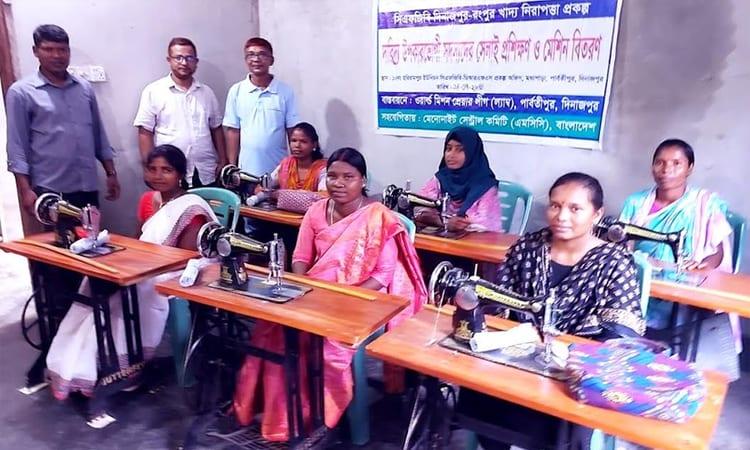
In a quiet ceremony at the Dinajpur-Rangpur Food Security (DRFS) project office, six vulnerable women from Harirampur union in Parbatipur upazila of Dinajpur received sewing machines to enhance their livelihoods. The initiative, supported by LAMB, Mennonite Central Committee (MCC) Bangladesh, and funded by Canadian Foodgrains Bank (CFGB), aims to provide sustainable income-generating opportunities. The women, who completed a month-long tailoring training, are now equipped to start small tailoring businesses and generate regular income.
Utpal Minj, Director of LAMB's Community Health and Development Programme (CHDP) department, highlighted the significance of the initiative. "Empowering women through livelihood opportunities not only improves household income but also contributes to their community development and poverty reduction," he said.
The beneficiaries, Mostarina, Rima Murmu, Anita Baroar, Lipi Linduar, Sabrina Hembrom, and Sabina Hasda, come from different villages in the union. Each will receive individualized business planning and regular follow-up support over the next year to help establish profitable tailoring enterprises.
The DRFS project, which has been operating since 2025, supports 400 vulnerable households through various livelihood development interventions. These include training on on-farm and off-farm income-generating activities, improved agricultural technologies, market system development, and awareness of social development issues.
Robert Marandi, project team leader, emphasized the initiative's goal to strengthen women's economic empowerment, enhance household resilience, and contribute to sustainable poverty reduction. "LAMB continues to implement integrated development initiatives that combine livelihood promotion, food security, skills development, and community empowerment to improve the well-being of vulnerable families in its working areas," he said.