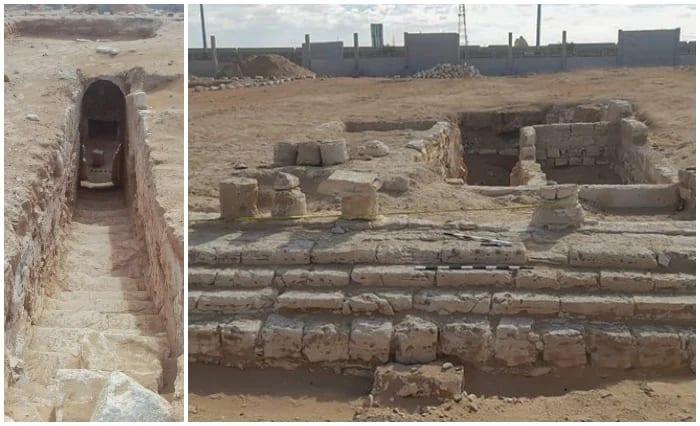
Egyptian archaeologists have uncovered a series of nearly 2,000-year-old tombs on the Mediterranean coast and the remains of a planned Byzantine-era city in the western desert, the tourism and antiquities ministry announced. The coastal discovery was made at Marina El-Alamein, about 100 kilometres west of Alexandria, where recent excavations uncovered 18 Greco-Roman tombs. Several burial chambers were discovered with their original stone blocking slabs still in place, and a granite sarcophagus measuring about 2.5 metres was found with its lid intact, suggesting the graves had remained sealed for nearly two millennia.
Coastal Tombs Discovery
Inside the tombs, archaeologists found human remains alongside pottery, amphorae, and other funerary objects. Among the most notable finds were 24 gold objects placed inside the mouths of several individuals, a funerary practice associated with beliefs about the afterlife. The site is believed to correspond to the ancient city of Leukaspis, a Mediterranean port that flourished between the Hellenistic and Byzantine periods. This latest discovery brings the total number of known tombs at Marina El-Alamein to 44 since the site was first identified in 1986 during construction work.
Desert Byzantine City
Separately, in the Dakhla Oasis in Egypt's western desert, archaeologists uncovered the remains of a Byzantine-era settlement at Ain al-Sabil, dated to around the 4th century AD. The city, built of mudbrick, features a planned street grid, public squares, residential buildings, a basilica-style church, and defensive structures, indicating an organised urban community in the desert interior. The site also yielded around 200 ostraca written in Coptic and Greek, along with bronze and gold coins, including examples linked to the reign of Roman emperor Constantius II (337-361 AD).
Significance and Tourism
Egypt has been trying to boost its tourism revenues, with high-profile archaeological finds frequently used to showcase the country's cultural heritage and draw international visitors. Tourism is a key source of foreign currency, alongside Suez Canal revenues and remittances from Egyptians working abroad. These discoveries not only provide valuable insights into ancient Egyptian and Byzantine life but also hold the potential to attract more tourists to these historically rich sites.
Why This Matters
For Bangladesh, understanding these ancient civilizations can offer insights into the historical and cultural exchanges that have shaped the region over millennia. Moreover, such archaeological discoveries highlight the importance of preserving cultural heritage, which can inspire similar efforts in Bangladesh to protect and promote its own historical sites.