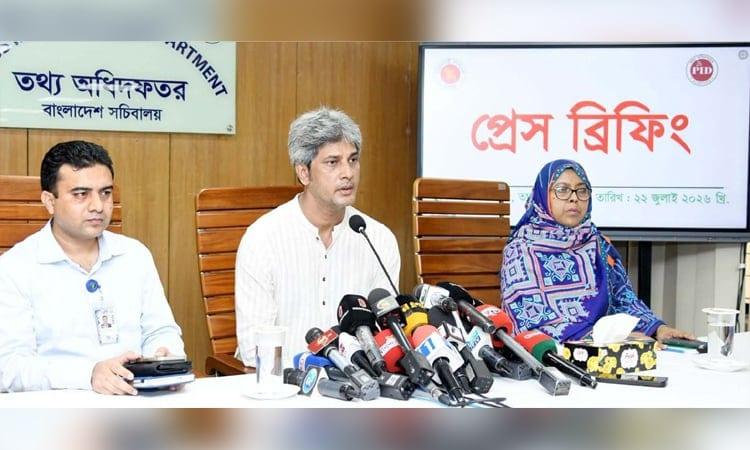
The government has undertaken a comprehensive set of measures to overhaul Bangladesh’s public project implementation system by reducing delays, strengthening accountability, introducing a new policy for appointing project directors (PDs), revising construction rate schedules, and improving monitoring through digital platforms, said State Minister for Planning Md. Zonayed Abdur Rahim Saki today.
Reform Initiatives
Briefing reporters at the PID after the meeting of the Executive Committee of the National Economic Council (ECNEC) at the Cabinet Division, presided over by Prime Minister and ECNEC Chairman Tarique Rahman, the state minister said the initiatives are aimed at ensuring faster implementation of development projects, preventing unnecessary expenditure, and making public investment more effective as the government prioritizes economic recovery.
The ECNEC meeting approved eight development projects involving a total estimated cost of Tk 14,041.21 crore. Another project on protecting Shibpur, Dhonia, and Medua areas under Bhola Sadar and Daulatkhan upazilas from erosion by the Meghna River was returned with observations for revision.
Addressing Delays and Accountability
Saki said the government inherited a project implementation system plagued by procedural delays, weak coordination, overlapping responsibilities, and inadequate accountability, which often resulted in significant cost overruns and delayed completion of development projects.
The Prime Minister reviewed every project in detail and issued project-specific observations and directives focusing on eliminating wasteful expenditure, improving financial discipline, and ensuring greater value for taxpayers’ money. Every approved project will now be implemented in accordance with those directives.
Comprehensive Implementation Framework
The state minister noted that a project often requires one-and-a-half to two years after ECNEC approval merely to complete procedural formalities and receive work orders. This lengthy process significantly affects ADP implementation and delays the expected economic benefits of public investment.
The government is therefore preparing a comprehensive implementation framework to simplify project approval procedures, reduce bureaucratic delays, and ensure quicker execution. Ongoing projects and those included in the 'green pages' of the Annual Development Programme (ADP) are being reviewed through a process of're-scoping'.
Digital Monitoring and Institutional Reforms
The Planning Ministry is implementing four major reform initiatives. The first is the preparation of a five-year strategic development framework, which has already been approved in principle by the National Economic Council (NEC). Secondly, the ministry is developing a digital dashboard that will allow real-time monitoring of every development project.
Thirdly, the ministry is reviewing institutional weaknesses responsible for delays in project implementation and preparing recommendations to address them. A draft policy for appointing Project Directors is also being prepared, seeking to introduce transparent appointment procedures, specialized training, competency-based selection, and structured institutional capacity-building for PDs.
Fourthly, the government is pursuing extensive automation across the Planning Division, IMED, the Bangladesh Public Procurement Authority, the Bangladesh Bureau of Statistics, the National Board of Revenue, the Office of the Comptroller and Auditor General, Bangladesh Bank, and ICT-related citizen databases so that these institutions can function through an integrated digital platform.
Cost Increases and Accountability Measures
Answering a question about the repeated cost increase of the Dhaka-Ashulia Elevated Expressway despite around 80 percent completion of physical work, Saki said the additional expenditure resulted mainly from exchange rate adjustments, changes in VAT and tax calculations, relocation of utility lines that had not been included in the original Development Project Proposal (DPP), and the inclusion of five additional project components.
On accountability, Saki said the preliminary investigation report on the delayed Rupsha road construction project in Khulna, prepared by a probe committee headed by the Cabinet Secretary, was placed before the ECNEC meeting. The Prime Minister directed the authorities concerned to determine responsibility and take appropriate action against those found responsible in accordance with the findings of the investigation.
Optimism for Reforms
Expressing optimism about the reform agenda, the state minister said the government expects to complete the major institutional reforms within six months. 'Once implemented, the new system will substantially improve project implementation, strengthen public accountability, enhance ADP execution, and contribute to accelerating Bangladesh’s economic recovery and sustainable development,' he added.