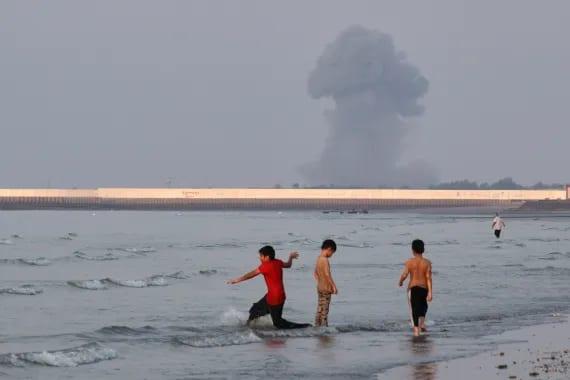
The United States military has launched its 13th consecutive night of strikes against Iran, targeting military installations with the aim of diminishing Iran's ability to attack shipping in the region. Iranian state media reported that US missiles struck the city of Ahvaz, near the border with Iraq, as well as the port city of Bandar Abbas on the Strait of Hormuz and Omidiyeh.
US President Donald Trump announced that Washington would start using frozen Iranian assets held by the United States to cover any damages incurred by ships, cargo, or related entities in the region. Meanwhile, Kuwaiti air defences intercepted incoming Iranian missiles and drones following a new attack at the border crossing with Iraq.
The US House of Representatives passed a largely symbolic resolution urging President Trump to halt military action against Iran, calling for the withdrawal of US forces unless Congress explicitly authorises the war. The ongoing conflict has drawn international condemnation, particularly regarding attacks on oil tankers in the Red Sea by Yemen's Houthi militants.
UN Secretary-General Antonio Guterres warned that the Middle East conflict is 'getting out of control,' with oil prices surging as a result of the instability. The benchmark international oil contract, Brent North Sea, soared more than eight percent to reach $101.93 a barrel, while the main US oil contract, West Texas Intermediate, rose 7.6 percent to $93.44 a barrel.
President Trump threatened Yemen's Houthi rebels with 'major military punishment' if they continue their attacks, holding Iran responsible as the Houthis are considered a proxy. Britain has withdrawn its remaining diplomatic staff from Iran due to the escalating security situation. The situation underscores the growing instability in the region, with significant implications for global oil markets and international relations.