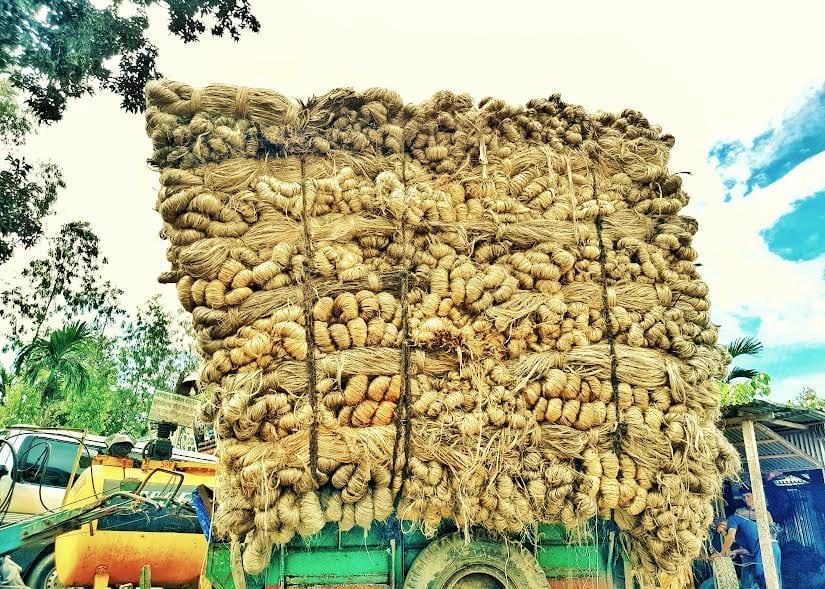
Despite a price surge in the jute market, farmers in Lalmonirhat district are grappling with financial uncertainty as excessive rainfall and flooding have significantly reduced jute yields. Although prices are higher than last year, farmers report that heavy rains disrupted the normal growth of jute plants, leading to reduced production.
According to local farmers, most jute plants this season are between two and five feet shorter than usual, resulting in a decline of around 40 to 60 kilograms of fiber per bigha. While jute plants typically grow between seven and 13 feet, many fields have failed to reach the expected height this year.
Jute trading has already started in union-level markets across Sadar, Aditmari, Kaliganj, Hatibandha, and Patgram upazilas. Field visits revealed that waterlogging has severely affected crop growth in some areas, where plants reached only three to five feet in height, while in relatively unaffected fields they grew between six and eight feet.
Jute trader Akkas Ali of Lalmonirhat Sadar noted that the opening market price this season ranges between Taka 4,000 and Taka 4,400 per maund, compared to Taka 3,400 to Taka 3,800 during the same period last year. Despite the price increase, many farmers are concerned about their profit margins given the reduced yields.
Farmer Amir Ali from Aditmari upazila said he sold his jute at Taka 4,000 per maund. Another farmer, Santosh Roy of Kaliganj upazila, expressed concern over how long the current price would remain stable, as much of the crop has yet to be harvested and processed. Habibur Rahman, a farmer and pesticide dealer from Panchagram union in Sadar upazila, highlighted that cultivating one bigha of jute costs about Taka 16,000, and due to excessive rainfall, production dropped to around six maunds per bigha, leaving a net profit of only Taka 8,000 after production costs.
The Department of Agricultural Extension (DAE) reports that jute has been cultivated on 4,045 hectares of land in the district this season, an increase of 730 hectares from last year. However, the production target of 49,549 metric tonnes may not be met due to the adverse weather conditions. Sadar Upazila Agriculture Officer Khandaker Sohel Ahmed noted that excessive rainfall during the sowing and seedling stages hampered the normal growth of jute plants.
Deputy Director of the district DAE Dr Md Saikhul Arifin said jute prices are encouraging this season. However, while production has declined in some flood-affected areas due to excessive rainfall, satisfactory yields are still expected in many other parts of the district. Farmers are urging the government to introduce effective financial support to help mitigate their losses.