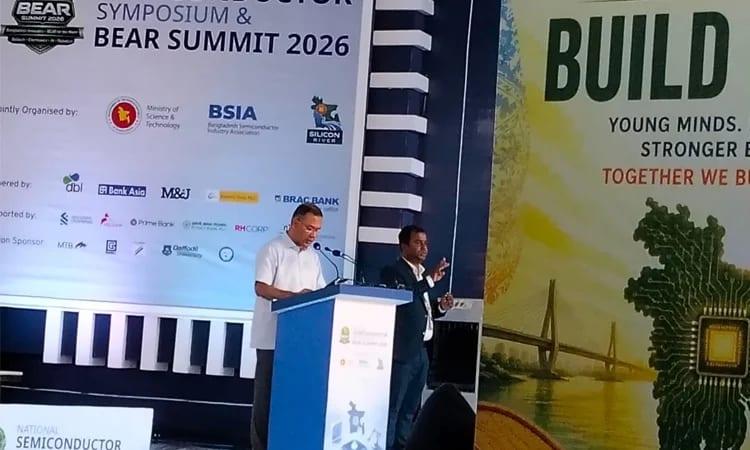
Prime Minister Tarique Rahman today emphasized the government's comprehensive plan to harness the potentials of the semiconductor industry, describing it as the country’s next major economic growth engine after the RMG sector. Speaking at the inaugural ceremony of the National Semiconductor Symposium and BEAR (Bangladesh Electronics, AI and Robotics) Summit-2026, the prime minister highlighted the crucial role of semiconductors in modern technology and the global market's vast potential. He stressed the need for collaboration among the government, universities, research institutions, industrialists, entrepreneurs, and expatriate experts to achieve this national mission.
“The semiconductor industry could emerge as Bangladesh's next promising economic sector after the RMG industry. The government has already started implementing comprehensive plans, including creating a business-friendly environment, to transform this next major driver of economic prosperity into reality,” he said.
The prime minister described the conference as a gathering of those who would help build a technology-driven Bangladesh in the future. He noted the significant contributions of Bangladeshi expatriates in various countries and their participation in the summit.
“From artificial intelligence, robotics, data centres, renewable energy and medical equipment to mobile phones and satellites in space, chips or semiconductors are indispensable in every field,” said Tarique Rahman, calling semiconductors the foundation of modern civilisation in the era of the Fourth and Fifth Industrial Revolutions.
Highlighting the enormous potential of the global semiconductor market, the prime minister said, “The global semiconductor market is expected to reach nearly one trillion US dollars by 2026. Bangladesh has immense opportunities in this vast market, and I believe the country will be able to achieve its targeted export earnings from this sector by 2030.”
The premier added that the government, universities, research institutions, industrialists, entrepreneurs and expatriate experts must work together to achieve this goal. He stressed that the development of the semiconductor industry is a collective national mission and not the responsibility of any single ministry or institution.