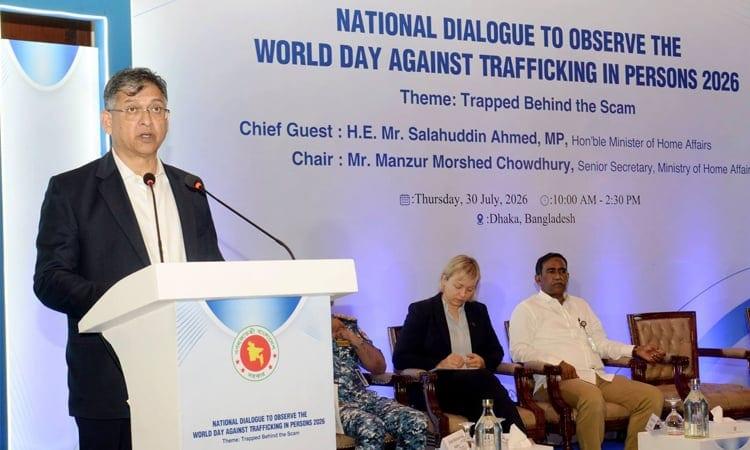
Home Minister Salahuddin Ahmed announced today that the government has adopted a 'zero tolerance' policy against human trafficking and technology-enabled transnational scam networks. The minister emphasized that protecting citizens from trafficking and cyber-enabled exploitation remains a top priority. He made these remarks while speaking at a high-level national dialogue titled 'Trapped behind the Scam: Ending Human Trafficking for Forced Criminality' at Pan Pacific Sonargaon Hotel, marking the World Day Against Trafficking in Persons 2026.
Ahmed highlighted that trafficking syndicates are increasingly using fake online recruitment platforms and social media to lure job seekers, particularly young people, with false promises of overseas employment. Many victims are later confined in cyber scam centers abroad, where they are subjected to torture, intimidation, and forced criminal activities.
The minister stressed that conventional law enforcement alone is no longer sufficient to tackle the evolving threat and called for stronger collaboration among technology companies, financial institutions, the private sector, and civil society. He noted that Bangladesh has enacted the Human Trafficking and Migrant Smuggling (Prevention and Suppression) Act, 2026, aligned with the UN Convention against Transnational Organized Crime (UNTOC) and its protocols.
This law brings online scam-related trafficking, technology-enabled deception, and forced criminality under stricter legal penalties. Salahuddin also mentioned that the government is updating the Human Trafficking Prevention and Suppression Rules, 2017, while finalizing the National Action Plan (2026-2030) focusing on prevention, protection, prosecution, and partnership.
To strengthen victim support, the government is enhancing the National Referral Mechanism (NRM) to ensure timely rescue and provide legal, medical, psychological, and rehabilitation services. A digital trafficking information management platform is also being developed to improve case tracking and evidence-based policymaking.
The minister urged the media and civil society to raise awareness among youths, women, and prospective migrant workers about safe migration and the risks posed by fraudulent recruitment networks. The dialogue was chaired by Senior Secretary of the Home Ministry Manzur Morshed Chowdhury and attended by senior government officials, diplomats, law enforcement representatives, and international partners.