Jagaddhatri, an incarnation of Goddess Durga, humbled the arrogance of the gods by challenging their powers with a mere blade of grass. The gods, Indra, Agni, Vayu, and Varuna, failed to stop the grass, revealing their dependence on divine power.
The name Jagaddhatri signifies the sustainer of the universe. After the defeat of Mahishasura by Durga, the gods became arrogant, forgetting the source of their strength. Jagaddhatri, with four arms instead of ten, confronted them to remind them of their true power.
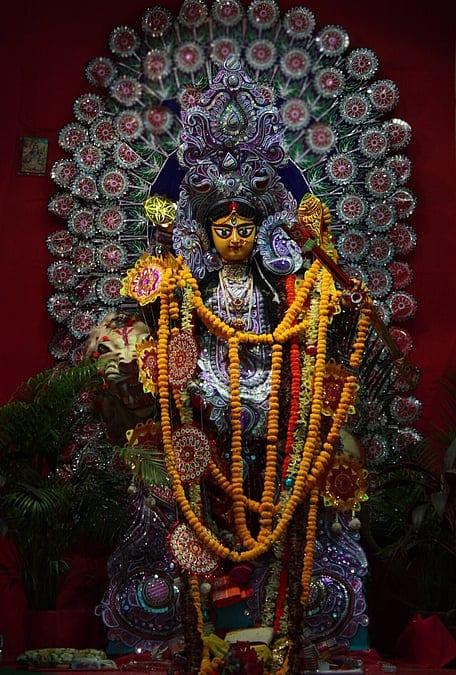
In Hindu mythology, Jagaddhatri is depicted with a lion as her vehicle, holding a conch, bow, discus, and a five-arrowed bow. Her reddish-orange complexion and three eyes symbolize her divine essence.
The worship of Jagaddhatri is prominent among Bengali Hindus, with historical records dating back to the 15th century. Archaeological findings and terracotta sculptures from the 18th century further attest to her significance.
Jagaddhatri Puja is celebrated on the ninth day of the bright fortnight in the month of Kartik. The rituals vary, with some observing it for three days and others on the ninth day alone.