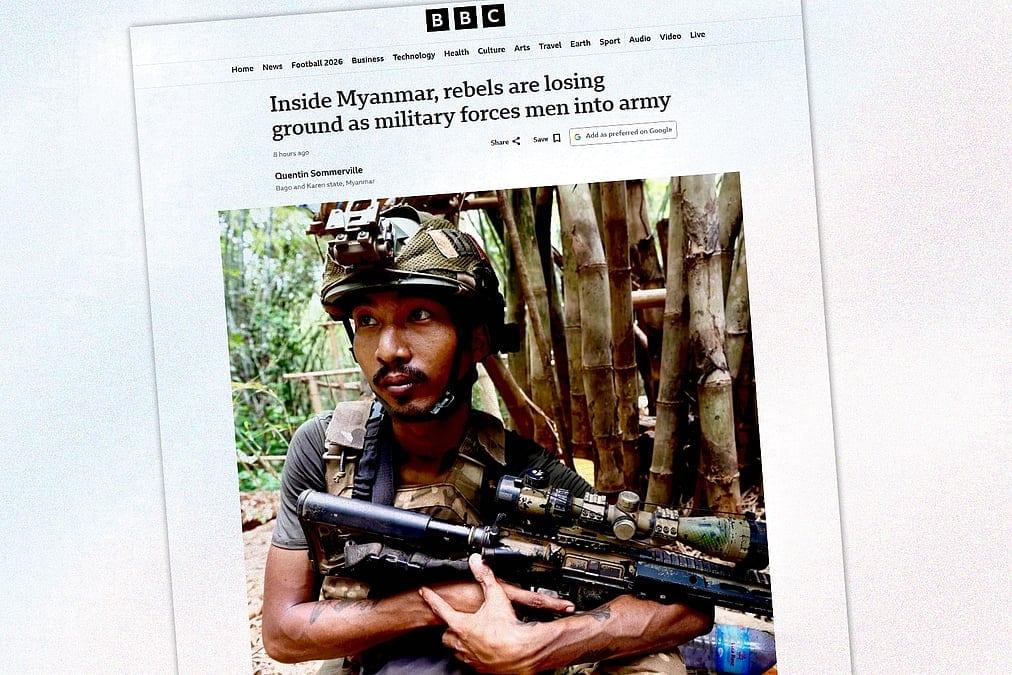
Myanmar's military junta has begun to gain success against the rebels following the implementation of the junta government's mandatory conscription law in 2024. The forced conscription of a large number of soldiers has significantly increased the junta's strength; additionally, the security agreement with Russia has provided them with additional advantages. On the other hand, the rebel groups, facing severe financial and weapon shortages, are now forced to adopt defensive positions in most parts of the country, halting their previous progress. This has been reported by BBC's Quentin Sommerville.
In a rebel camp deep in the jungle-covered hills, four young men who had been forcibly conscripted into the military now hide, no longer wishing to participate in Myanmar's civil war. None of them had voluntarily joined the military; they were all forcibly conscripted. One of them, a chef, was arrested on his way home from work for not carrying an ID card. Another was arrested on his way back from a late-night karaoke session. The third was a forest department employee at the time of his arrest. The fourth claims that drugs were secretly planted in his shoes during his arrest, leading to a false charge and forced conscription into the military.
These four men, aged between 19 and 25, spoke to the BBC. One of them said, 'Before we even understood what was happening, we were sent directly to the battlefield.' Another said, 'They made us do things we didn't want to do. We never got any real rest—not in the morning, not during the day, not even at night.' The young man hiding claims that those forcibly conscripted into the military had to do all the work, while the regular soldiers hardly had to do anything.
After being forcibly conscripted, they underwent four months of training before being sent to fight in Karen State. One night, while going for a bath, they decided to escape. However, they ended up in the hands of a nearby rebel People's Defense Force (PDF) patrol and were detained. These four young men will stay with the PDF for now and will later be taken to the Thailand border. They fear that if they return to their hometowns, the military might find them again.
The current reality of Myanmar's ongoing civil war is that even though these four young men do not wish to return to the military, the junta army's mandatory conscription policy has changed the dynamics of the war. In many parts of the country, the rebels are now retreating under military pressure. The current junta army took power in Myanmar through a military coup in 2021, overthrowing the democratically elected government. Since then, the country has been in a state of civil war.
The civil war has fragmented Myanmar. Thousands have been killed, and lakhs have been displaced. More than two years ago, an alliance of ethnic and rebel groups had made significant progress across the country, winning one victory after another against the junta army. Once in an offensive position, this rebel alliance is now in a defensive position in most parts of Myanmar.
Although the military junta does not control more than half of Myanmar, they have made some progress. They have captured important suburbs and re-captured a crucial road from Mandalay in the north to Myitkyina. Thousands of soldiers are conducting intense campaigns to re-establish control in border areas such as Kachin, Chin, and Karen states.
BBC representatives traveled to Myanmar without the junta's permission. They had no other way to report from rebel-controlled areas. BBC representatives spent 10 days there, interacting with rebel fighters and reporting on the war in temporary hospitals and battlefields in Bago and Karen states.
Ko Kaung, commander of the PDF battalion, says that the junta government implemented a mandatory conscription law in 2024, requiring a minimum of two years of service in the military. These forcibly conscripted soldiers have made the biggest difference. Kaung says, 'The mandatory conscription for the military has become our main challenge on the battlefield because it has given the military unlimited manpower.'
Despite their technological and intellectual advantages, Kaung admits their resources are very limited. Due to limited funds, they cannot gather as many necessary materials as they need, nor can they easily recruit new soldiers like the military. Ko Kaung and his forces had taken control of Hpapun town and a large military base in Karen State two years ago. The town bears the scars of war. The welcome sign at the town's entrance has been blown up by a bomb. Similarly, the town's school, a local monastery, and most of the now-abandoned houses have been damaged.
But now, Kaung is preparing for the worst. Because the junta's drones are circling in the sky, and nearly two thousand soldiers are advancing towards Hpapun. Myanmar's military is much better armed than the rebel forces fighting against them. Returning to the hill camp, PDF commander Da Wa admits that the forcibly conscripted soldiers are a problem for them.
Da Wa, who was involved in Myanmar's politics and spent four and a half years in prison, says that although many were conscripted against their will, they are gradually improving as fighters because they are becoming more adept at following orders. Like Ko Kaung, Da Wa faces significant challenges. The military around the area under his control is trying to strengthen their position. Nearly 400 soldiers are advancing towards Da Wa's forces.
However, it's not just the forcibly conscripted soldiers; Da Wa says the junta army's tactics have also changed. After signing a security agreement with Russia, their air power has increased. Da Wa says, 'Now we see planes in pairs, whereas before we usually only saw one fixed-wing plane.' Da Wa also believes the junta army is in a favorable position in terms of technology and numbers regarding drones. Ko Kaung agrees with him.
Da Wa says, 'The (threat of) drones is definitely increasing. If we had jammers, it would have made things easier for us... It depends on how effectively we can counter their drone attacks and how well we can protect ourselves.'
Apart from these, a few other factors are changing the war situation, such as ceasefire agreements initiated by China. China has invested billions of dollars in Myanmar and is extracting rare minerals from Karen and Kachin states. Therefore, China has mediated with several rebel groups. At the same time, it has severely limited the supply of weapons and ammunition to the resistance forces.
Kyar Swe, a platoon commander injured in the war, says, 'The shortage of weapons is a big problem.' Kyar Swe is being treated at a temporary medical center deep in the jungle. From there, he says, 'So far, everyone wants to fight. But there are significant weaknesses in some areas. There is a significant shortage of weapons and ammunition.'
Kyar Swe was severely injured after stepping on a landmine. Myanmar is one of the most landmine-contaminated countries in the world. Last year alone, 745 people were killed or injured in landmine explosions in the country, a quarter of whom were children. Most of Kyar Swe's right ankle was blown off in the landmine explosion. But he has not given up. Kyar Swe says, 'I will return to the fight. I will fight to the end, no matter what. Because now there is no way for me to return home.'