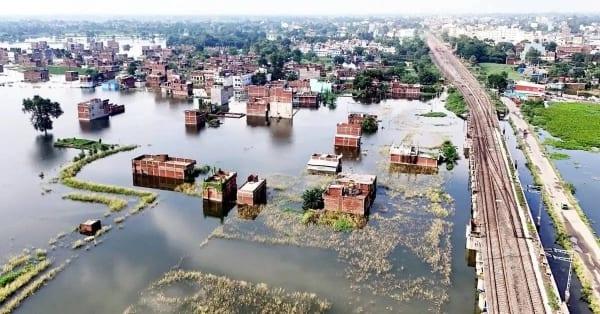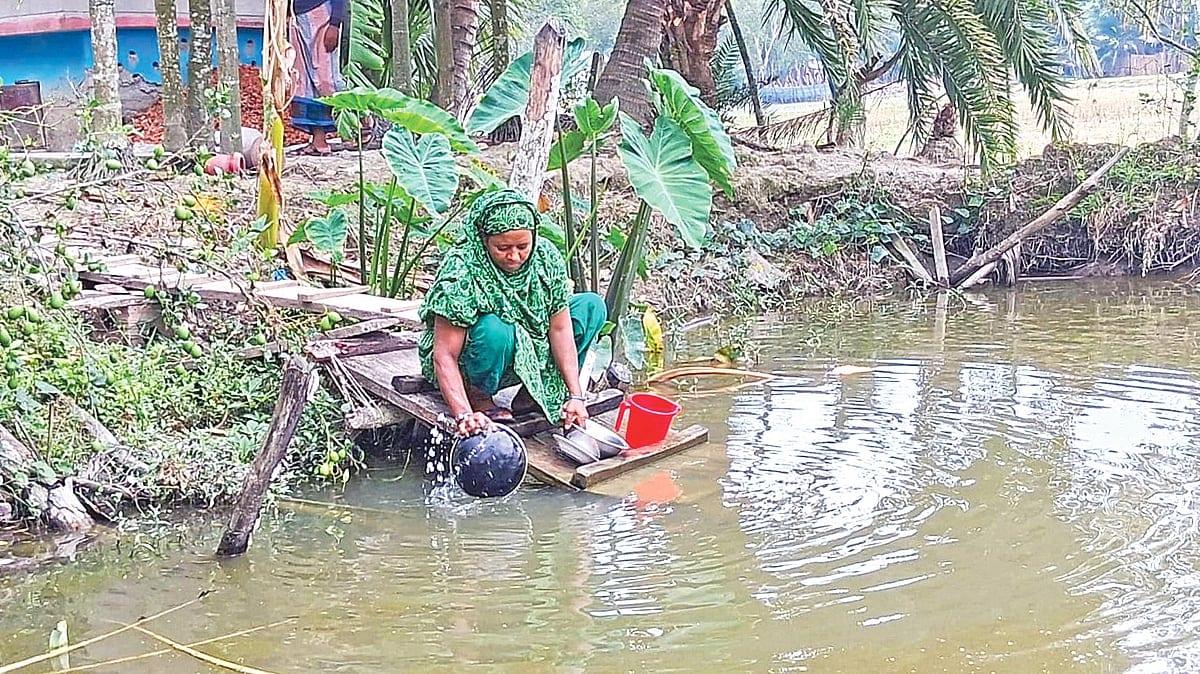
The salinity in deep tube well water in various districts of Barisal division is posing a threat to public health and agriculture. The salinity level in many coastal rivers of the South has already exceeded the tolerable limit. Now, abnormal salinity is being detected in deep tube well water. As a result, the water that was once a source of life is now bringing silent danger to people's bodies. At the same time, the salinity of agricultural land is increasing, and crop production is decreasing, which has become a major threat to the coastal livelihood and food security.
According to experts, long-term consumption and use of excessively salty water is causing high blood pressure, kidney complications, pregnancy health risks, and various diseases of the uterus and reproductive system in women. At the same time, people working in saline water for a long time are at risk of skin diseases and infections. Researchers warn that if effective initiatives are not taken to stop the spread of the safe water crisis and salinity, the health and livelihood crisis in the South may become more severe.
Researchers from the Soil Resources Development Institute (SRDI) Barisal Regional Office report that the salinity level in the Tentulia River near Galachipa in Patuakhali was 0.87 dS/m in March 2021, which increased to 1.75 dS/m in March of the current year. In the Boleshwar River near Patharghata in Barguna, the salinity was 4.56 dS/m in April 2021, which increased to 5.88 dS/m in April 2025. At the same time, the salinity in the Payra River of the district increased from 1.8 to 3.90 dS/m.
In the Meghna River near Borhanuddin in Bhola, the salinity level was 0.68 dS/m in April 2022, which reached 25.31 dS/m in April 2024. This salinity level has spread about 70 to 100 kilometers upstream. However, the salinity level in the Andharmanik River in Kalapara, Patuakhali, decreased from 22.20 dS/m in March 2021 to 15.21 dS/m in March 2026.
Researchers from SRDI tested the deep tube well water (1,000 to 1,200 feet deep) in several coastal areas in March of the current year. The test found abnormal salinity in the groundwater. In Badarpur of Galachipa upazila in Patuakhali, the salinity in deep tube well water was 1.27 dS/m, in Panpatti area of the upazila, it was 1.33 dS/m, in Payrakunj area of Mirzaganj, it was 1.02 dS/m, in Newmarket area, it was 0.92 dS/m, and in Tiakhali of Kalapara upazila, it was 1.33 dS/m.
In Charpara village of Taltali in Barguna, the salinity in deep tube wells was 2.35 dS/m, in Baroitala area of Sadar, it was 1.60 dS/m, and in Betagi municipal area, it was 2.04 dS/m. According to the Department of Public Health Engineering Barisal's Executive Engineer Mo. Imran Tarafdar, the acceptable salinity level for drinking water is 500 mg/L, but the maximum tolerable limit in coastal areas is 1,000 mg/L. He also said that although this is considered the maximum tolerable limit due to the scarcity of safe water in coastal areas, it is still harmful, as long-term consumption of this level of saline water poses various health risks.
The Chief Scientific Officer of Barisal Regional Soil Resources Development Institute, AFM Mamun, told Prothom Alo that the tolerable salinity level in river water is 0.7 dS/m. However, the salinity level in all rivers in the South is much higher than this. Even a decade ago, the salinity level in these rivers was not this high. Especially, there was no salinity this far upstream. As a result, unbearable salinity has been found in groundwater sources, which is a warning sign for public health in this region.
In the village of Chhota Ankujanpara on the Bay of Bengal coast in Taltali upazila, the village is shrinking due to the erosion of the Payra River. In the cyclone Sidr of 2007, about 45 people died in this village. On May 10, it was seen that many adolescent girls and women of various ages were catching shrimp larvae in the Payra River with small nets. Kohinur Begum (30) said that they catch fish in the river for six months a year. After staying in waist-deep saline water for three to four hours, their hands and feet become pale. Due to the lack of alternative sources of income, they are forced to go into the river.
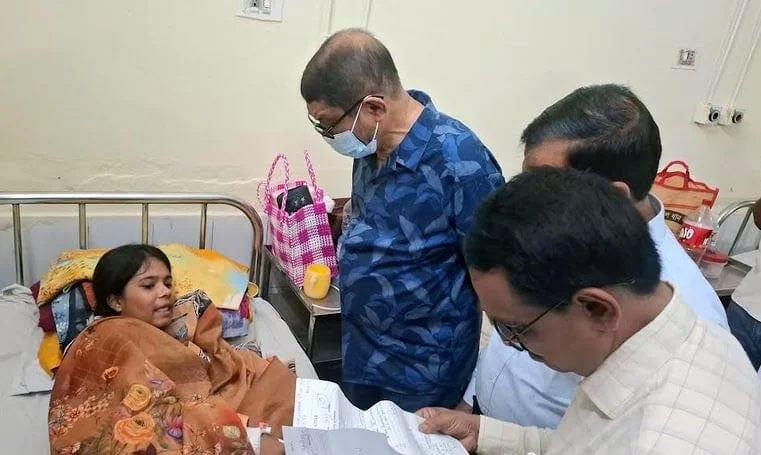
At least 35 women aged between 21 and 50 were interviewed in the village. They all suffer from uterine complications, menstrual problems, and high blood pressure. At least eight of them have had their uterus removed through surgery. One woman, despite suffering from a serious problem, is not getting married, and her family is not willing to take the risk. Several of them also suffer from kidney problems.
Experts say that staying in waist-deep saline water for hours to catch fish or bathing in it can increase the risk of infection in a woman's reproductive system and affect the normal menstrual cycle. Retired Professor of Gynecology Department of Sher-e-Bangla Medical College, Shikha Rani Saha, told Prothom Alo that the use of unclean water in toilets in these areas is exacerbating this problem. She believes that pure water is needed only for drinking, not for toilet use. As a result, they suffer from various types of infections. In addition, their poor nutrition reduces their immunity, leading to various uterine problems due to lack of hygiene. Therefore, awareness needs to be increased.
Dulal Hossain (55) of Chhota Ankujanpara village had been suffering from high blood pressure for a long time. Recently, he sought medical help due to some complications in his body. The doctor informed him that he had kidney problems. Dulal Hossain said, 'I used to catch fish in the river. Due to my deteriorating health, I started a small fish business to somehow run my family; but now, due to kidney complications, I can't afford treatment or run my family. I can't think of anything.'
Dulal's wife, Kulsum Begum, had to undergo surgery to remove her uterus after suffering from problems for a long time. She said, 'This problem is now in every household. Women are suffering from irregular menstruation, excessive bleeding during menstruation, white discharge, itching, and various complications. Women do not want to disclose these health problems for various reasons. As a result, there is no option left but to remove the uterus after it becomes complicated.'
Another woman, Amena Begum (34), also had her uterus removed. She said, 'We use saline water for everything, from food to bathing. Even the clothes we use during menstruation, we wash and clean them in saline water.'
The severe impact of salinity on women's health has been highlighted in a study. Funded by the Ministry of Science and Technology, the Community Health and Hygiene Department of Patuakhali Science and Technology University conducted a study on this issue in June 2018.
The study surveyed 100 women (with children under five years old) from Tiakhali and Baliatli unions of Kalapara upazila. Water samples from deep tube wells, ponds, and canals in the area, as well as urine samples from the participating women, were collected and tested in the university's lab. The test showed that 58% of the women were consuming more than two grams of sodium per day, which is higher than the World Health Organization's recommended level. This has had a visible impact on the women's urine and blood pressure.
The study found that none of the participating women were aware of the health problems caused by high salinity. They only knew about gastric problems, skin diseases, rheumatism, and high blood pressure. However, some respondents mentioned bladder irritation, painful urination, gynecological problems, bleeding and miscarriage, cardiovascular diseases (heart disease and blood vessel disease), asthma, and allergies.
Professor Litton Chandra Sen of the Community Health and Hygiene Department of Patuakhali Science and Technology University told Prothom Alo that the study found evidence of high blood pressure, pre-eclampsia, and other health problems due to salinity.
According to a 2009 survey by the SRDI Barisal Regional Office, the excessive salinity has reduced the cultivable land in Barguna district by 17,440 hectares, in Patuakhali by 36,390 hectares, in Bhola by 12,770 hectares, and in Jhalokati by about 1,000 hectares. As a result, the amount of land unsuitable for crop production in these four districts, known as the granary of the South, has reached 67,600 hectares.
In the last 16 years, the amount of saline land has increased further. According to the latest data released by the Barisal Agriculture Extension Department in 2024, out of the 802,000 hectares of cultivable land in the division, 415,000 hectares or 52% are affected by salinity. The most affected district is Patuakhali, with 155,180 hectares affected.