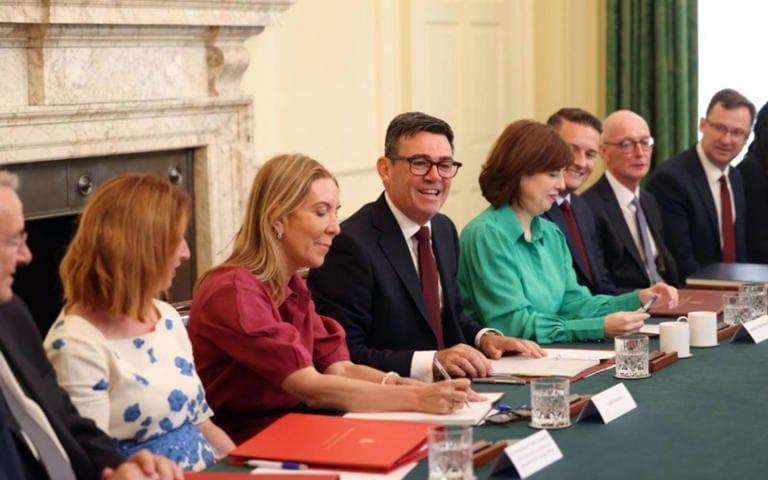
British Prime Minister Andy Burnham has opened his new northern office in Manchester, aiming to decentralise power and spur economic growth across England. The 'Number 10 North' hub, which Burnham will visit at least once a week, is intended to reverse decades of centralising power in London. Burnham has vowed to put'more power into every postcode', arguing that local communities should have greater control over their own affairs. However, some experts argue that the new office represents 'de-concentration' rather than true devolution, as it does not transfer any law-making power. Burnham has also re-established the National Economic Council, which will meet for the first time at the new office. Critics argue that the new office is unlikely to challenge the central power of the Treasury.
FAQ
Q: What is the purpose of 'Number 10 North'? A: The purpose of 'Number 10 North' is to decentralise power in the UK and give more control to local communities. Prime Minister Andy Burnham aims to visit the office at least once a week to oversee this process.
Q: Is 'Number 10 North' a form of devolution? A: Some experts argue that 'Number 10 North' represents 'de-concentration' rather than true devolution, as it does not transfer any law-making power. However, others see it as a positive step towards greater local control.
Q: What is the National Economic Council? A: The National Economic Council is a body that was originally created in 2008 to deal with the economic fallout from the global financial crisis. Prime Minister Andy Burnham has re-established the council and will chair its first meeting at 'Number 10 North'.
Q: Will 'Number 10 North' challenge the central power of the Treasury? A: Critics argue that the new office is unlikely to challenge the central power of the Treasury, as the Treasury has historically resisted attempts to decentralise power.