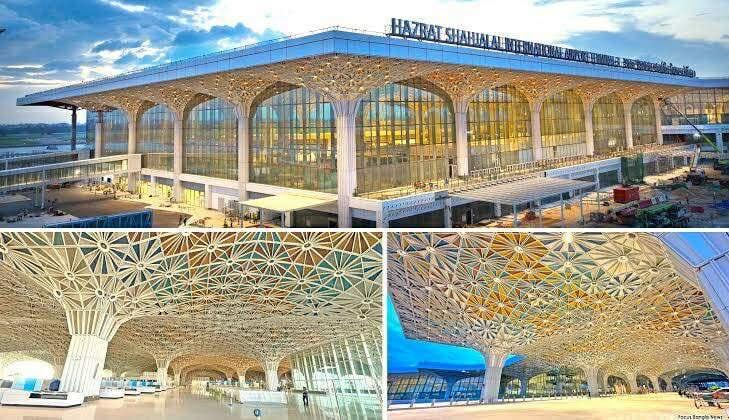
The government is set to establish one of its most advanced indoor telecommunications networks at the Third Terminal of Hazrat Shahjalal International Airport (HSIA), ensuring seamless voice and high-speed data services across key passenger and operational zones without coverage gaps. According to official documents, the project will deploy an advanced Active Distributed Antenna System (Active DAS) integrated with hundreds of small cells and Wi-Fi access points. The system is designed to deliver uninterrupted, high-capacity 4G and future-ready 5G connectivity throughout the terminal complex.
Project Details and Scope
The Tk 47.63 crore project is being implemented by the state-owned Teletalk Bangladesh Limited with full funding from the Government of Bangladesh. Of the total project cost, Tk 43.54 crore has been allocated as capital expenditure, mainly for telecommunications infrastructure including core network equipment, transmission systems, Active DAS components, small cells and Wi-Fi devices. Another Tk 2.244 crore has been earmarked for revenue expenditure covering electricity, transport, training and maintenance, while Tk 25 lakh has been kept as physical and price contingency. The implementation period runs from July 2023 to June 2027.
Importance and Impact
The digital infrastructure is also being built with future aviation technologies in mind. Besides ensuring continuous connectivity for passengers, airlines and airport agencies, the 4G/5G-compatible network is expected to support next-generation airport operations as demand grows, creating a scalable communications backbone for one of the country’s most strategic transport hubs. The project will extend mobile network coverage across the Third Terminal, including immigration areas, check-in counters, VIP lounges, the Export Cargo Terminal (ECT), the Import Cargo Terminal (ICT) and other critical indoor facilities.
Current Challenges and Future Outlook
Project documents note that the newly built terminal currently lacks comprehensive in-building mobile coverage, resulting in weak signals, dropped calls and slower internet services in several indoor locations. The new telecommunications infrastructure is intended to eliminate these limitations by ensuring consistent network performance throughout the terminal. The initiative also aligns with the government’s election manifesto, which prioritizes the expansion of free high-speed internet services at airports and other major public facilities.